
Executive Summary
The global diamond market in 2025 is experiencing a fundamental transformation driven by shifting consumer preferences, evolving market structures, and significant geopolitical factors. The most pronounced trend is the dramatic shift toward elongated fancy shapes particularly oval, marquise, emerald, and elongated cushion cuts which are outperforming traditional round brilliants in critical market segments above two carats.
This consumer-driven movement toward individuality and perceived value coincides with challenges in the supply chain, including tariff pressures, increased scrutiny of synthetics, and a growing divide between high-quality and mediocre goods.
For buyers, the market presents opportunities to acquire distinctive stones with excellent visual impact, provided they prioritize cut quality. For sellers and investors, understanding these dynamics is essential for inventory strategy and global positioning. This comprehensive analysis explores the drivers behind these trends, provides regional market insights, and offers strategic guidance for navigating the 2025 diamond landscape.
Introduction:
The diamond industry in 2025 stands at a significant crossroads. After decades of round brilliant dominance, consumer tastes have decisively shifted toward personalized expression and maximized visual impact. Concurrently, external pressures are reshaping traditional trade flows and pricing structures. The imposition of punitive U.S. tariffs on diamonds, particularly those sourced from India, has created profound uncertainty and disrupted established supply chains. At the same time, the natural diamond industry is engaged in a concerted effort to redefine its boundaries and messaging against the backdrop of an expanding synthetic diamond market.
Understanding this landscape requires examining it from multiple angles: consumer preferences that drive demand, supply-side constraints that affect availability, and macroeconomic factors that influence global trade. The data reveals not just a passing trend but a structural realignment of what consumers value in a diamond and how the industry responds to those values.
The Reign of Elongation: A Deep Dive into the Dominant Trend
Core Drivers of Demand for Long Fancy Shapes
Several interconnected factors are fueling the unprecedented demand for elongated fancy cuts:
Perceived Size and Value: The most immediate and practical appeal of an elongated diamond is its optical efficiency. By distributing its mass across a longer table, a well-proportioned oval or marquise can appear visually larger than a round brilliant of the same carat weight. For instance, a 2.5-carat oval may rival the finger coverage of a 3-carat round, offering consumers a way to maximize the visual impact of their investment. This is a primary driver in the strong performance of shapes like ovals and marquises in the coveted 2+ carat category.
Individualistic Expression and Celebrity Influence: The modern diamond buyer, particularly from Millennial and Gen Z demographics, increasingly views their jewelry as a personal signature rather than a conventional symbol. The clean lines of an emerald cut or the vintage romance of a long cushion offer a distinct alternative to the ubiquitous round brilliant. This shift has been powerfully validated by high-profile celebrity engagements featuring fancy shapes, which normalize and glamorize these choices for a broad audience.
Aesthetic Versatility and Flattery: Elongated shapes are celebrated for their universally flattering effect on the hand, creating a slimming and lengthening visual line. Furthermore, their form lends itself to a wide array of contemporary and classic setting designs, from sleek solitaires and elegant three-stone arrangements to intricate halos that enhance their silhouette.
Market Performance and Supply Constraints -
The market data from late 2025 confirms that this is more than a stylistic preference, it's an economic reality with clear price implications.
Marquise: The Premium Leader: Market reports consistently identify the marquise cut as the most expensive fancy shape available. This premium is driven by extreme rarity at high quality levels. Cutting a marquise with perfect symmetry and minimal "bow-tie" effect (a dark, shadowy area across the width) is a master-level task that results in significant rough diamond waste. Consequently, finding a well-cut marquise over 2 carats is exceptionally challenging, creating a severe supply bottleneck that supports its top-tier pricing.
Explore these rare gems in CaratX's curated Marquise cut diamond collection.
Oval: The Sustained Favorite: Oval diamonds continue their meteoric rise, representing a perfect synthesis of tradition (the brilliance of a round) and modernity (the elongated silhouette). In the U.S., there is particularly intense demand for ovals in the D–I color range and VS–SI clarity range, indicating consumers are prioritizing excellent cut and larger size over the absolute highest grades. Notably, U.S. oval prices command a 5% to 10% premium over equivalent pear shapes, attributed to the oval's preferred symmetrical balance.
Elongated Cushion & Radiant: High-Demand Hybrids: The elongated cushion cut demonstrates one of the most dramatic price differentials. Long cushions are trading at a 20% to 25% premium over their square counterparts, driven by strong sales velocity. Similarly, high-quality long radiant cuts which combine the trimmed corners of an emerald cut with brilliant-style faceting are noted as being in short supply, making them prized for collectors and designers.
Discover the unique geometry of these stones in CaratX's Radiant cut diamond inventory.
The Critical Importance of Cut Quality -
A defining feature of the 2025 market is the extreme polarization in the value and desirability of fancy shapes based on cut quality. This "flight to quality" means the gap between a well-cut and a poorly-cut elongated diamond has never been wider.
The Premium for Excellence: Very well-cut fancy shapes are difficult to find and command significant premiums. For brilliant cuts (oval, marquise, pear), excellence means a vibrant, even pattern of light with a minimal bow-tie. For step cuts (emerald), it means perfectly parallel facets and exceptional clarity.
The Illiquidity of Poor Proportions: Conversely, fancy shapes with bad proportions are becoming difficult to sell. Stones with severe bow-ties, windowing (lifeless, transparent areas), or poor symmetry are heavily discounted and languish in inventory. This underscores that the modern, educated consumer, armed with online resources and high-resolution videos, will not accept poor craftsmanship.
Global Market Analysis: Regional Dynamics and Diverging Sentiments
The global diamond trade is not a monolith. Regional economic conditions, consumer sentiment, and trade policies create a patchwork of market environments.
United States: Selective Strength in a Steady Market
The U.S. market, the world's largest for diamond jewelry, shows steady demand but with a highly selective character.
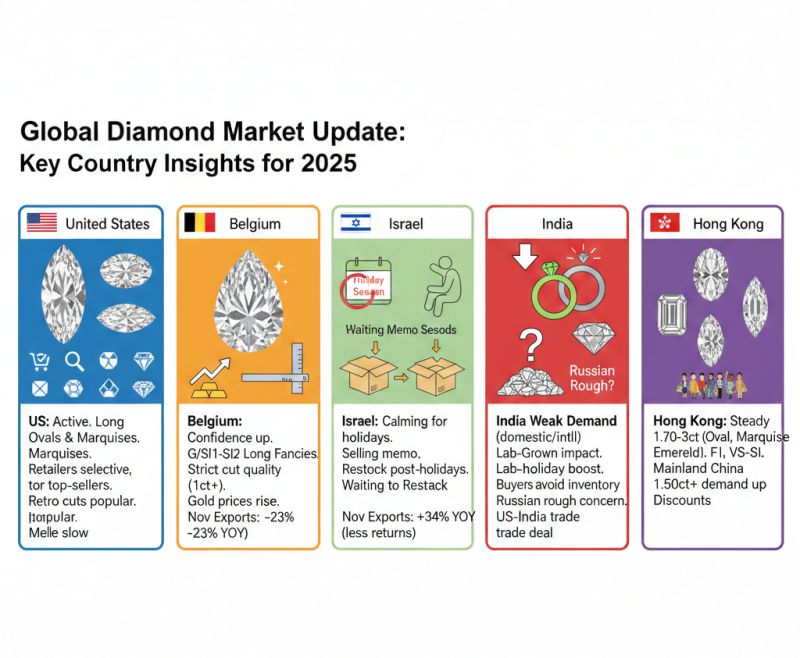
Trend Alignment: U.S. buyers are actively pursuing the long fancy shapes dominating global trends. Long ovals and marquises are noted as particularly "hot," and there is a resurgence of interest in retro cuts like old mine and old European brilliants.
Inventory Caution: Retailers are carefully managing stock, taking goods on memo (consignment) and only buying the most sought-after items for outright inventory. This selectivity means that undesirable goods are piling up for suppliers, while premium items move quickly.
Tariff Impact: The U.S. market is also the epicenter of significant trade disruption. The imposition of tariffs escalating to 50% on Indian-origin rough and polished diamonds as of late August 2025 has increased costs, tightened supply, and created profound uncertainty for the entire value chain.
India: Manufacturing Hub Under Pressure
India, which handles an estimated 90% of the world's polished diamond manufacturing, faces a uniquely challenging environment.
Demand Softness: Business is described as sluggish for the time of year, with both overseas and domestic trading slow. Buyers are reluctant to take on inventory, and the market is awaiting news on a potential U.S.-India trade deal.
Specific Segment Weakness: The market for smaller fancy shapes (0.30 to 0.79 ct. ovals and pears) is softening, with the notable exception of "ideal long models". This further illustrates the market's bifurcation: only the best examples in the most desirable profiles retain their value.
Competitive Threats: The industry is contending with the impact of synthetic diamonds on the natural market and concern over cut-price rough coming from Russia.
Hong Kong & China:
The Hong Kong market shows steady interest in the key trend categories, particularly for goods between 1.70 and 3 carats in F-I color and VS-SI clarity ranges for oval, emerald, and marquise shapes.
Holiday Uptick: Local activity is picking up ahead of the holiday season, aided by an influx of overseas visitors.
Premium on Size: Mirroring a global pattern, goods under 1 carat are weak, while the Chinese appetite for diamonds of 1.50 carats and larger is improving. However, mainland retailers are discounting ahead of the festive season, and stores are reporting low sales volumes, suggesting a cautious consumer.
European Centers: Belgium and Israel
Belgium: Market sentiment in Antwerp is more positive than in previous periods, with a good market for long fancies, especially in G color and SI1-SI2 clarity. Buyers are notably picky about cut quality in stones 1 carat and larger.
Israel: Activity is slowing ahead of the holiday season, with retailers focusing on selling memo goods and waiting to replenish inventory until after the season.
Investment and Purchasing Implications
Price Drivers and Value Considerations
For those looking to purchase or invest in diamonds in the current market, several key principles emerge:
Cut is King, Especially for Fancies: In elongated shapes, an excellent cut is non-negotiable. It is better to choose a stone with a slightly lower clarity grade (e.g., SI1) that is brilliantly cut than a higher-clarity stone that is poorly proportioned and lifeless. The resources of the Gemological Institute of America (GIA) and the International Gem Society (IGS) are invaluable for understanding how cut quality impacts beauty and value.
Understand the Length-to-Width Ratio: For ovals and marquises, a ratio between 1.45 and 1.65 is generally considered most pleasing and classic. However, personal preference reigns supreme. Dramatically elongated stones (e.g., over 1.7) offer a fashion-forward look but are a more specific taste.
Balance the 4Cs Strategically: The strong U.S. demand for ovals in the D-I, VS-SI ranges indicates a savvy approach. Consumers are finding value by not overpaying for the highest color or clarity if it means sacrificing carat weight or cut quality. An F-color, SI1-clarity diamond with an ideal cut can deliver exceptional brilliance and value, appearing as beautiful as a top-graded stone to the naked eye in everyday settings.
Strategic Guidance for Buyers -
Prioritize Visual Inspection: Always review high-definition videos and images. A certificate tells only part of the story; a diamond's true character is revealed in motion and under various lighting conditions. Be vigilant for unacceptable bow-tie effects or windowing.
Consider the Setting: Elongated shapes offer tremendous versatility. A simple solitaire highlights their clean lines, while a three-stone setting or a halo can amplify their presence and sparkle. For shapes with points (marquise, pear), ensure the setting includes protective V-prongs.
Work with Reputable Platforms: Given the market's polarization, sourcing from platforms that provide detailed assessments, high-quality visuals, and access to a global inventory of vetted stones is crucial.
Navigating the Market: A Guide for Sellers and Industry Professionals
For sellers, the current trends represent both a challenge and a significant opportunity for profitability.
Curate for Quality and Trend: The market is unequivocally rewarding high-quality, well-cut elongated goods. Inventory strategy must focus on stones with excellent proportions and symmetry, particularly in the shapes commanding premiums: marquise, long oval, elongated cushion, and long radiant.
Leverage Global Market Access: To capitalize on specific demand in different regions such as large ovals in the U.S. or specific color/clarity combinations in Belgium sellers need efficient access to a broad, international clientele. Digital marketplaces are essential for this global reach.
Expand into Finished Jewelry: The trend extends beyond loose diamonds. There is robust consumer demand for finished jewelry featuring these popular shapes. Sellers can capture more value by offering designed pieces. Platforms like the CaratX seller plan enable jewelers to seamlessly list and sell diamond jewelry internationally to both B2B and B2C buyers.
Articulate Value and Provenance: In an era of synthetic competition and demand for transparency, being able to tell a diamond's story its cut quality, natural origin, and ethical journey adds intangible value.
The CaratX marketplace is engineered to help sellers meet these strategic imperatives. By registering as a seller, you can launch your products to a global audience of buyers in 18+ countries who are actively searching for the precise diamonds and jewelry trending in 2025.
Conclusion:
The 2025 diamond market is defined by a decisive consumer shift toward elongated elegance, personal expression, and uncompromising quality. The data confirms that this is not a fleeting trend but a structural recalibration of value within the industry. Marquise, oval, and elongated cushion cuts are not just fashionable; they are achieving measurable price premiums and sales velocity that outperform traditional rounds in key categories.
However, this opportunity is not without its conditions. Success hinges on a relentless focus on superior cut quality. The market is ruthlessly separating the exceptional from the mediocre, making education and access to well-curated inventory more important than ever.
Embrace the new era of diamond elegance. Whether you are looking to acquire a stunning elongated fancy diamond or are a professional aiming to capitalize on this dominant trend, the CaratX platform provides the global marketplace, curated selection, and expert resources you need.
For Buyers: Explore our unparalleled collection of long fancy shape diamonds. For Sellers: Register on the CaratX marketplace to start selling to an international audience.
Frequently Asked Questions (FAQs)
Q1: Are elongated fancy shape diamonds a good investment compared to round brilliants? A1: Investment value depends on many factors. Currently, high-quality elongated fancy shapes (especially marquise, long oval, and elongated cushion) in sizes above 2 carats are commanding significant premiums and showing strong demand, suggesting good potential for value retention. However, they must be very well-cut. Poorly proportioned fancies are illiquid. Rounds remain a timeless, liquid choice, but the unique rarity of top-tier fancies can make them compelling.
Q2: I've heard the "bow-tie effect" is a problem in ovals and marquises. What is it, and how do I avoid it? A2: The bow-tie is a dark, shadowy band that can appear across the width of some elongated brilliant cuts due to light leakage. A faint bow-tie is common and often acceptable, but a severe, dark bow-tie significantly reduces a diamond's beauty and value. The only way to assess it is through careful visual inspection of high-resolution videos and images. A well-cut stone will minimize this effect.
Q3: How do U.S. tariffs affect the price of the diamond I want to buy? A3: Tariffs, particularly the 50% duty on diamonds of Indian origin, act as a consumption tax, increasing the final cost to the American consumer. This has contributed to rising prices in the mid- to higher-value segments. The full impact depends on the diamond's provenance and how the supply chain has adapted. It underscores the importance of working with knowledgeable sellers who can navigate these complexities.
Q4: Is there a difference in durability between round and elongated fancy shapes? A4: All diamonds are durable, but some shapes require more thoughtful setting. Rounds have no weak points. Shapes with points (like marquise and pear) or sharp corners (like princess) are more prone to chipping at those extremities if struck. These shapes should always be set with protective V-prongs or bezels to safeguard the points. For daily wear, a well-set elongated diamond is perfectly suitable.
Q5: As a small or medium-sized jeweler, how can I source these in-demand long fancy shapes efficiently? A5: The key is accessing a broad and liquid marketplace. Traditional channels may have limited inventory of these specific, high-demand items. A global B2B digital platform like CaratX allows you to search and source directly from a worldwide network of suppliers, ensuring you can find the ideal stones for your clients without holding excessive inventory. Register as a seller to explore the available inventory and connect with global buyers.
Sources and Citations -
This analysis is synthesized from trade reports, market commentaries, and industry publications. Key sources include:
Rapaport - The trade's trusted bulletin for weekly pricing and trend data, providing the core observations on fancy shape performance and regional market conditions.
CIBJO Diamond Special Report 2025: Offers high-level analysis of structural industry challenges, including synthetic diamond labeling and the impact of U.S. tariff policies.
CaratX Market Analysis ("The Reign of Elongation"): Provides detailed insight into the consumer drivers and specific market dynamics behind the trend toward elongated fancy shapes.
The Diamond Press News Roundup (November 2025): Supplies relevant data on corporate earnings, trade figures, and industry developments that contextualize the market environment.
Explore and Engage with the Market:
For Buyers & Collectors: Discover our unparalleled global collection of long fancy shape diamonds and gemstones at Shop Natural Diamonds and Shop Gemstones.
For Sellers & Jewelers: Register on the CaratX Marketplace to launch your products and start selling to a qualified international audience in 18+ countries today.