
Introduction:
The Akashic Records a concept originating from ancient Sanskrit traditions and later embraced by Theosophists like Helena Blavatsky and Rudolf Steiner are believed to be an invisible cosmic archive containing every thought, action, and creation across all time and space . While scholars may debate the metaphysical existence of such records, what remains undisputed is that ancient Egypt left behind a material archive so complete, so intentionally preserved, that it functions as its own kind of eternal memory bank.
If we open this archaeological record and listen carefully, Egypt speaks in three powerful voices: the Old Kingdom, Middle Kingdom, and New Kingdom. Each kingdom was not merely a chronological era, it was a distinct mindset, a unique design language, a measurable frequency expressed through the jeweler's art.
This article presents a jewelry heirloom collection crafted from those frequencies designed as if they were remembered, not invented. Drawing on archaeological evidence from museum collections, peer-reviewed Egyptological research, and the spiritual properties of ancient gemstones, we explore how Egyptian jewelry functioned as data storage for the soul and how these timeless patterns continue to influence modern luxury design.
OLD KINGDOM (c. 2686–2181 BCE):
Akashic Insight:
The Old Kingdom encompassing Dynasties 3 through 6 represents what many Egyptologists consider the apex of ancient Egyptian civilization. This was the age that built the Great Pyramid of Giza, the Sphinx, and established the artistic and architectural conventions that would endure for 3,000 years . The Step Pyramid of Djoser at Saqqara, constructed around 2600 BCE, marked the first king's tomb built entirely of stone a 545 × 280 meter sculpture that announced Egypt's mastery over matter .
According to the Australian Museum, everyone wore jewelry in ancient Egypt, from poor farmers to wealthy royals. However, for the elite, jewelry was never mere decoration it was imbued with magical qualities designed to protect the wearer from disease, ward off evil, and bring good fortune . This was especially critical for the afterlife, where jewelry functioned as essential equipment for the soul's journey.
Archaeological Evidence:
The most significant Old Kingdom jewelry discovery comes from Tomb G 7000 X at Giza, belonging to Queen Hetepheres, mother of King Khufu (builder of the Great Pyramid). The tomb yielded numerous fragments of silver bracelets decorated with inlays of lapis lazuli, turquoise, and carnelian .
The presence of lapis lazuli in Old Kingdom burial contexts is particularly significant. This deep cosmic blue stone, sourced from the distant Badakhshan mines in modern-day Afghanistan, was more valuable than gold. As noted by gemstone historians, lapis lazuli was "used widely by the Pharaohs of Egypt for its powerful ability to bring about insight and spiritual transformation" . Known as a "stone of royalty and spirituality," it carried "the vibration of the inner King or Queen that lies within us" .
Heirloom Creation:
Drawing directly on Old Kingdom design principles and burial practices, we conceptualize:
The Egyptian Eternal Amulet is crafted using raw, hammered gold in its unpolished form, symbolizing eternity and the divine essence, as gold was believed to be “the flesh of the gods.” At its center lies a deep cosmic blue Lapis Lazuli gemstone, representing the heavens, divine protection, and heightened spiritual awareness.
The design features a geometric pyramid suspended within a circular sun disc, where the pyramid acts as an energy anchor connecting earthly and cosmic forces, while the sun disc embodies the presence of Ra, the source of life and creation.
Hidden within the structure is an inner chamber engraved as a cartouche, intended to hold the wearer’s “name of the soul,” reflecting the ancient belief that preserving one’s name ensured eternal life.
This amulet serves a powerful spiritual purpose, functioning as protection beyond death and playing a vital role in guiding the soul through the weighing of the heart ceremony, ensuring safe passage, identity preservation, and continuity in the afterlife.
Energy Meaning
Stability: The pyramid's geometric perfection.
Immortality: Gold's incorruptible nature.
Divine Order: Ma'at, the cosmic balance.
For today's discerning collector, this heirloom translates into a minimalist gold pendant with a bold lapis center where ancient geometry meets contemporary luxury. Such pieces echo the Old Kingdom's understanding that true luxury serves both beauty and metaphysical purpose.
Shop natural gemstones, including premium lapis lazuli, at CaratX Marketplace.
MIDDLE KINGDOM (c. 2055–1650 BCE):
Akashic Insight:
The Middle Kingdom spanning Dynasties 11 through 13 represents what many scholars consider Egypt's classical age. Following the political fragmentation of the First Intermediate Period, the reunification under King Mentuhotep I around 2040 BCE ushered in a cultural renaissance .
Unlike the remote, godlike depictions of Old Kingdom pharaohs, Middle Kingdom art reached its peak with royal portraits of unusual psychological depth the faces of Kings Sesostris II and Amenemhet III showing weariness, contemplation, and human vulnerability . This era saw a shift from monumental architecture toward personal piety, literature, and self-awareness.
Archaeological Evidence:
One of the most distinctive Middle Kingdom jewelry forms was the snake head amulet, known as Menqet or Mekert. The Egypt Centre at Swansea University (a UK university museum) holds significant examples of these carnelian pendants, dating to approximately 2055–1650 BCE .
According to the Egypt Centre's collection documentation, these amulets are described in Spell 101 of the Book of the Dead and were "typically placed at the throat of the mummy" serving a protective function "to safeguard the deceased from snake bites in the afterlife" .
Carnelian the primary gemstone used in these amulets was chosen for its blood-red color, symbolizing life force and the protective blood of the goddess Isis.
The Scarab:
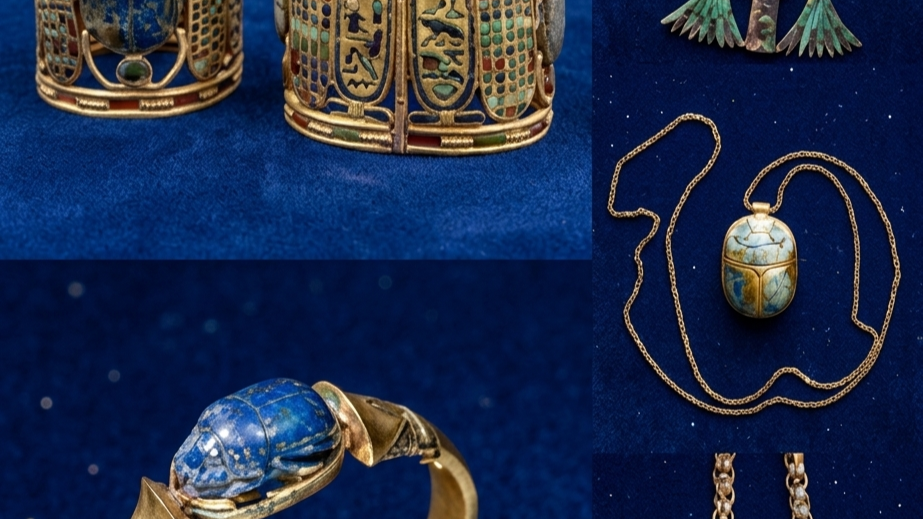
The Middle Kingdom also saw the widespread adoption of the scarab as a preferred burial object. According to ars mundi's historical analysis, scarabs were "often decorated with the name of the deceased" and "were supposed to ensure life after death".
The heart scarab specifically was placed over the dead person's heart to protect it during the Weighing of the Heart Ceremony a critical moment where the heart, containing "a record of all the person's actions in life," was weighed against the feather of the goddess Ma'at .
Heirloom Creation:
This Egyptian-inspired amulet is crafted in polished gold with smooth, fluid curves that symbolize the life-giving flow of the Nile. It is adorned with alternating emeralds and carnelian gemstones, where emeralds represent rebirth and renewal, while carnelian embodies vitality and the essence of life force.
The design takes the form of a coiling serpent wrapping gracefully around the wrist, with its head resting near the pulse point, signifying protection and a deep connection to the rhythm of life. The serpent itself reflects the role of a protective deity, guarding the wearer while channeling continuous energy.
Hidden within the piece are delicate micro-inscriptions of ancient prayers for protection and rebirth, inspired by Spell 30B from the Book of the Dead, reinforcing its spiritual purpose. Unlike funerary amulets, this piece is intended for the living, serving as a powerful symbol of emotional balance, vitality, and the harmonious flow of life energy.
Energy Meaning
Transformation: The serpent shedding its skin
Healing: Carnelian's association with life force
Continuity: The eternal return of the Nile's flood
Modern CaratX Adaptation -
The Nile Serpent translates into a flexible snake bracelet with colored gemstone gradients elegant, symbolic, and wearable daily.
For jewelers and collectors interested in authentic carnelian and emerald pieces, register as a seller on CaratX to access our global marketplace of certified gemstones.
NEW KINGDOM (c. 1550–1070 BCE):
Akashic Insight:
The New Kingdom Dynasties 18 through 20 represents Egypt at its zenith. Following the expulsion of the Hyksos (Asian invaders who had dominated the Second Intermediate Period), Egypt entered an era of empire, conquest, and global influence . Pharaohs like Hatshepsut, Thutmose III, Akhenaten, Tutankhamun, and Ramesses II built monuments that still define our image of ancient Egypt.
According to ars mundi's historical overview, this period saw the construction of the Temple of Amun in Karnak, the impressive Avenue of the Sphinxes, and the terraced temple of Hatshepsut the first in a series of royal funerary temples on the west bank of Thebes . The discovery of Tutankhamun's tomb in 1922 gave modern archaeologists an unprecedented glimpse into the art, culture, and everyday life of an 18th Dynasty pharaoh .
The Amarna Revolution:
A fascinating New Kingdom development was the Amarna Period under Akhenaten (Amenhotep IV) , who briefly abandoned Egypt's traditional polytheism for the worship of Aten, the sun disc. During this period, colossal statues gave way to more "human" proportions, and the king was depicted "in the circle of his family with the symbol of sun rays" a radical departure from traditional formal representations .
Jewelry as Statement of Power -
New Kingdom jewelry reached unprecedented levels of technical sophistication and material opulence. The Australian Museum notes that jewelry from this period was increasingly designed to make statements of dominance and divine royalty. The falcon representing Horus, the sky god and divine protector of pharaohs became a dominant motif.
Gold-working techniques reached their peak. The Museum of Fine Arts Boston's collections from this period demonstrate mastery of cloisonné, granulation, and enamel work techniques that would not be surpassed until the Renaissance.
Heirloom Creation:
This striking Egyptian-inspired collar necklace is crafted in high-polish gold with intricate enamel inlays, capturing the brilliance of sunlight within its form. It features a powerful combination of turquoise, carnelian, and diamonds, where turquoise symbolizes protection, carnelian represents life force, and diamonds convey strength and invincibility.
The design takes the shape of a wide collar with a falcon representing Horus spreading its wings across the chest, embodying the idea of the pharaoh as the living incarnation of Horus, with the wings offering divine protection and authority.
Beneath each gemstone lies a hidden detail of finely etched solar rays, designed to reflect light like the sun, symbolizing Aten’s life-giving energy and the pursuit of enlightenment. This piece serves as a bold expression of authority, vision, and protection, reimagined as a statement of power for modern leaders.
Energy Meaning
Power: The falcon's dominion over sky and earth
Clarity: The sun's illumination
Expansion: Egypt's imperial reach
CaratX Adaptation -
The Solar Falcon Collar inspires a statement choker with bold geometry and multicolor stones designed for high-impact luxury buyers who understand that jewelry is both adornment and declaration.
Shop natural diamonds for such statement pieces through CaratX's curated marketplace.
Akashic Pattern Insight:
The Akashic Pattern Insight reveals a clear evolution in jewelry across the Three Kingdoms of Egypt, each reflecting a distinct purpose, design philosophy, and energy focus that continues to influence modern applications.
In the Old Kingdom, jewelry was deeply connected to the afterlife and eternity, featuring geometric and sacred designs crafted with gemstones like lapis lazuli, turquoise, and carnelian, all symbolizing stability; today, this translates into investment pieces and heirloom jewelry.
Moving into the Middle Kingdom, the focus shifted toward personal meaning and transformation, with more fluid and symbolic designs using carnelian, emeralds, and glass, representing change and inner growth, much like modern everyday luxury and personal amulets. In the New Kingdom, jewelry became a display of power and authority, characterized by bold and ornate styles adorned with turquoise, carnelian, and diamonds, channeling energy associated with leadership and dominance, which now inspires statement jewelry and high-impact designs for modern leaders.
How Ancient Gemstones Work
Lapis Lazuli:
Modern crystal healers and spiritual practitioners maintain that lapis lazuli "enhances telepathy, visionary awareness, past life recall, and deepens meditation". For those "interested in opening their third eye, recalling past lives, or those who are interested in Akashic records," lapis is considered essential.
The ancient Egyptians would have understood their use of lapis in burial contexts was precisely about accessing other realms of consciousness.
Carnelian:
The blood-red carnelian was associated with the goddess Isis and her protective blood. According to the Egypt Centre, carnelian snake head amulets were "placed at the throat of the mummy" to protect against snake bites but symbolically, the snake represented the threat of chaos, and the carnelian represented the life force that defeats it .
Turquoise:
Turquoise was associated with the goddess Hathor, the "Mistress of Turquoise" who presided over the Sinai mines where the stone was extracted. It was believed to provide protection, particularly for travelers and those journeying through the underworld.
Diamonds:
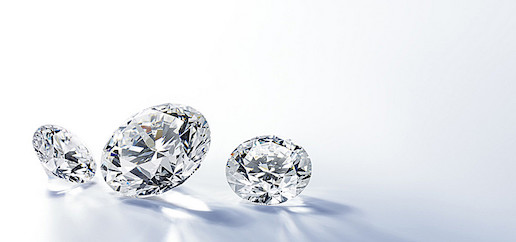
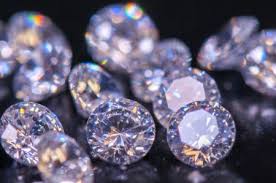
While diamonds were not used in ancient Egyptian jewelry (they were not discovered in significant quantities until later), their inclusion in the New Kingdom heirloom represents the expansion of luxury that characterized this era. Today, diamonds serve the same purpose as gold did for the pharaohs: supreme value, imperishability, and light refraction.
Lapis Lazuli:
Lapis lazuli from the Badakhshan mines in northeastern Afghanistan traveled thousands of miles to reach Egyptian workshops. This trade route one of the world's first long-distance commercial networks was established as early as the Predynastic Period (c. 4000–3100 BCE).
Carnelian:
Carnelian was more readily available, with sources in the Eastern Desert of Egypt and Nubia. The Egypt Centre notes that carnelian's use in Middle Kingdom amulets "reflects the intersection of Egyptian materials and Nubian burial contexts" and "highlights the value placed on semi-precious stones for apotropaic jewellery in funerary assemblages" .
Emerald:
While emeralds were known in the New Kingdom, their popularity increased during the Ptolemaic Period (332–30 BCE), when Cleopatra famously favored them. The Smaragdus mines at Wadi Sikait in the Eastern Desert became a major source of emeralds for the Greco-Roman world.
The Spiritual Technology Behind Egyptian Jewelry -
No discussion of Egyptian jewelry is complete without referencing the Book of the Dead a collection of funerary texts that provided instructions for navigating the afterlife. According to the Australian Museum, specific spells were inscribed on amulets to ensure their efficacy .
Why Ancient Egyptian Design Resonates Today -
The CaratX Philosophy
At CaratX, we approach jewelry design not as invention but as rediscovery. The patterns that worked for the pharaohs the use of sacred geometry, the combination of specific gemstones for specific purposes, the understanding of jewelry as data storage for identity continue to resonate because they address fundamental human needs:
Protection: We still seek talismans against uncertainty
Identity: We still use jewelry to declare who we are
Continuity: We still value objects that connect us to ancestors
Beauty: We still respond to the harmony of proportion and color
The CaratX Marketplace Advantage
For jewelers, designers, and collectors seeking to incorporate authentic ancient techniques and materials:
Shop Natural Diamonds — Certified stones with documented provenance
Shop Gemstones from CaratX Marketplace.
Register as a Seller — Access B2B and B2C buyers in 18+ international countries
Sell Jewelry Internationally — Through our CaratX seller plan
Review Pricing Information — Launch your products on our platform
Final Thought:
Jewelry was never just decoration in Egypt. It was data storage for the soul encoded with spells, shaped with sacred geometry, and constructed from materials that traversed continents to reach their final form.
Across the Akashic Records, these heirlooms still exist not only in museums, but in patterns we keep recreating today. The same deep blue lapis that Queen Hetepheres wore to the grave now adorns collectors seeking connection to eternity.
At CaratX , we don't just design jewelry. We rediscover what time has already written.
Frequently Asked Questions
Q1: What are the Akashic Records, and how do they relate to Egyptian jewelry?
The Akashic Records are a metaphysical concept describing a cosmic archive of all thoughts, actions, and experiences across time. While the ancient Egyptians did not use this Sanskrit term, their belief that jewelry could store spiritual data through spells, gemstone properties, and sacred geometry reflects a similar understanding that matter can encode meaning .
Q2: Why was lapis lazuli so valuable to ancient Egyptians?
Lapis lazuli was more valuable than gold because it had to be imported from the Badakhshan mines in modern-day Afghanistan one of the longest trade routes of the ancient world. Its deep blue color symbolized the heavens and divine protection.
Q3: What is the significance of snake amulets in Middle Kingdom jewelry?
Snake head amulets (Menqet or Mekert) were placed at the throat of mummies to protect against snake bites in the afterlife. This practice is documented in Spell 101 of the Book of the Dead. The Egypt Centre at Swansea University holds significant examples of these carnelian pendants .
Q4: How did the Amarna Period change Egyptian jewelry design?
During Akhenaten's reign (Amarna Period), artistic conventions shifted toward more naturalistic representations. Jewelry began incorporating sun ray motifs and more intimate family scenes, moving away from the formal, godlike imagery of earlier periods .
Q5: What is the heart scarab, and why was it important?
The heart scarab was an amulet placed over the mummy's heart to prevent it from betraying its owner during the Weighing of the Heart Ceremony. Spell 30B from the Book of the Dead was typically inscribed on the underside. The Australian Museum notes that this amulet was essential for ensuring entry into the afterlife .
Q6: Can I purchase authentic ancient Egyptian-style jewelry today?
Yes. Through CaratX, you can source natural gemstones including lapis lazuli, carnelian, turquoise, and emeralds and work with skilled jewelers to create pieces inspired by ancient Egyptian designs.
Shop gemstones or register as a seller to access our global marketplace.
Q7: How do I know if a gemstone is ethically sourced?
CaratX works with certified suppliers who adhere to international standards for ethical sourcing. Our marketplace provides documentation and certification for natural diamonds, gemstones, and finished jewelry.
Review our seller plan for detailed information.
Get Started Today
Sell Diamonds and Jewelry Internationally — Join our marketplace of vetted buyers
Shop Natural Diamonds — Certified stones at competitive prices
Shop Gemstones — Including lapis lazuli, carnelian, turquoise, and emeralds
Review Seller Plans — Detailed pricing and platform information
Follow CaratX for insightful and educational content on jewelry history, gemstone education, and luxury market trends.