

Anatomy of Emerald Cut Diamond - Clean Lines, Deep Clarity, and Hall-of-Mirrors Elegance
Home
News And Media Anatomy of Emerald Cut Diamond - Clean Lines, Deep Clarity, and Hall-of-Mirrors Elegance SHOP NOWHome
News And Media Anatomy of Emerald Cut Diamond - Clean Lines, Deep Clarity, and Hall-of-Mirrors Elegance SHOP NOWApr, 08, 2026 by Archit Mohanty 0 Comments

The emerald cut diamond stands apart in the world of gemstones. In an industry dominated by the intense, fiery brilliance of the round brilliant, the emerald cut offers a different kind of allure one built on clean lines, geometric precision, and a mirror-like clarity that feels both vintage and modern.
Unlike brilliant cuts that are designed to hide inclusions and maximize scattered sparkle, the emerald cut is a step-cut diamond that prioritizes transparency and structure. Its long, open facets create a unique optical phenomenon known as the “hall-of-mirrors” effect, where light reflects in broad, dramatic flashes rather than tiny, glittering bursts. This makes it the ultimate choice for connoisseurs who value purity, symmetry, and understated elegance over raw fire.
In this guide, we will dissect the exact anatomy of the emerald cut, explore its rich Art Deco history, decode the physics behind its signature glow, and provide actionable advice for buying a stone that balances beauty, clarity, and investment value.
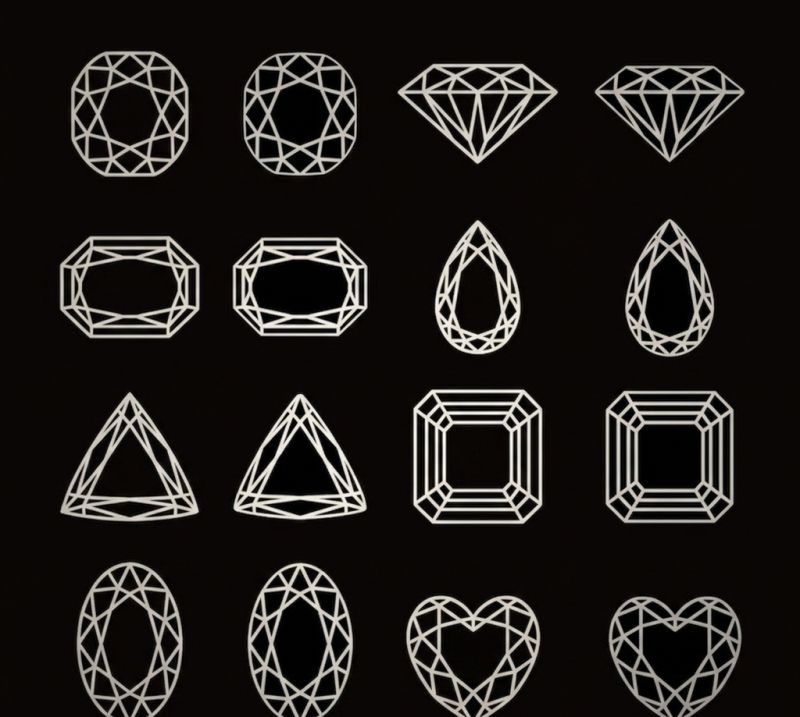
An emerald cut diamond is a rectangular or square-shaped gem with trimmed corners and concentric rows of step-cut facets on both the crown (top) and pavilion (bottom). The Gemological Institute of America (GIA) classifies it as a fancy shape, noting that the octagonal outline (when viewed from above) is one of the traditional fancy shapes alongside marquise, pear, and oval diamonds.
The defining feature of the emerald cut is its step-cut facet arrangement. Unlike the triangular or kite-shaped facets of a brilliant cut, step-cut facets run parallel to the girdle, creating a layered, terrace-like appearance. This structure prioritizes clarity and luster over dispersion (fire), making the emerald cut one of the most revealing diamond shapes available.
The emerald cut has a storied past that is deeply intertwined with the Art Deco movement of the 1920s and 1930s. Characterized by geometric shapes, symmetry, and streamlined designs, Art Deco jewelry embraced the emerald cut for its clean, architectural lines. The style originated in France in the 1910s and blossomed into a major decorative force across Western Europe and the United States by the 1930s. As the GIA notes, the emerald cut’s “simple, clean and symmetrical outline evokes the understated elegance we often associate with the era”.
The cut’s association with royalty and Hollywood glamour solidified its legendary status. In 1956, Princess Grace Kelly received a 10-carat emerald-cut engagement ring, cementing the cut’s place in jewelry history. Today, the resurgence of interest in vintage and architectural designs has brought the emerald cut roaring back into fashion, often spotted on celebrities like Beyoncé, Lauren Sánchez, and Amal Clooney.
To truly understand the emerald cut, you must look at its individual components. Each part works in harmony to produce the stone’s signature “hall-of-mirrors” effect and deep clarity.
The crown is the upper portion of the diamond, extending from the table (the large, flat top facet) down to the girdle. In an emerald cut, the crown features the table facet and several upper step facets. This is where light first enters the diamond.
Because the table is notably larger than in brilliant cuts, it acts as a clear window into the stone. While this amplifies the diamond’s clarity, it also means that any inclusions (internal flaws) or color tints are immediately visible to the naked eye. The crown’s flat planes reflect light in broad sheets rather than pinpoints, contributing to the cut’s calm, mirror-like glow.
The girdle is the thin outer edge that separates the crown from the pavilion. It serves as the setting border for the diamond. For emerald cuts, a medium to slightly thick girdle is preferred. This thickness provides durability, protecting the stone’s clean, straight edges from chipping during setting or daily wear. Because emerald cuts have sharp, angular corners (even with beveling), a well-proportioned girdle is critical for long-term safety.
The pavilion is the lower part of the diamond, extending from the girdle down to the culet (the point at the bottom). In an emerald cut, the pavilion features step-cut facets that run parallel to the girdle. These facets are responsible for collecting light and reflecting it back through the crown in those signature long flashes.
The depth of the pavilion plays a crucial role in brightness. If the pavilion is too shallow, light leaks out of the bottom, creating a dull, washed-out appearance. If it is too deep, light escapes from the sides, resulting in a dark, lifeless center. A well-cut pavilion creates a balanced play of light and dark zones often referred to as the “windowing” or “hall-of-mirrors” effect.
The most distinctive characteristic of an emerald cut diamond is its optical performance. Unlike the round brilliant, which relies on total internal reflection to create dazzling sparkle, the emerald cut creates a subtle, sophisticated glow.
The Physics of Diamond Sparkle Diamonds have a high refractive index of approximately 2.42, which means they bend light more dramatically than most other gemstones. The critical angle for total internal reflection in diamond is only about 24.5 degrees. In a round brilliant, facets are angled specifically to bounce light internally until it returns to the viewer’s eye.
The emerald cut, however, uses long, flat step facets that act as windows rather than mirrors. Light enters through the large table, travels through the pavilion, and reflects in broad, parallel bands. The result is not a “sparkle” but a hall-of-mirrors effect a series of alternating light and dark planes that flash as the diamond moves. This effect is mesmerizing in its own right, offering a sophisticated alternative to the chaotic fire of brilliant cuts.
Emerald cuts typically have between 49 and 57 facets, depending on the exact proportions and the number of step rows. While this is fewer than the 57–58 facets of a round brilliant, the facet structure is completely different.
The step-cut is characterized by concentric, parallel rows of facets on both the crown and pavilion. The Asscher cut is a close relative of the emerald cut but features a square outline and more rows of facets, often with a higher crown. As the GIA explains, step cuts like the emerald cut have “larger open facets” that “may reveal inclusions more easily, so those wishing for an eye-clean stone will need to go higher in clarity grade”.
Unlike round brilliant diamonds, emerald cuts do not receive a standardized cut grade from gemological laboratories like GIA. Instead, their beauty is judged subjectively based on proportions, symmetry, and polish. The most important proportion is the length-to-width ratio.
The length-to-width ratio is calculated by dividing the diamond’s length by its width. For a classic emerald cut, the ideal ratio typically falls between 1.30 and 1.50.
1.30 to 1.40: Produces a slightly squarish, chunky appearance, reminiscent of the Asscher cut.
1.40 to 1.50: The classic, balanced emerald cut that appears elegant and proportional on the finger.
1.50 to 1.70: A more elongated, slender emerald cut that creates a dramatic, finger-elongating effect.
In addition to the ratio, you should look for a depth percentage between 60% and 70% and a table percentage between 60% and 70% . These proportions ensure that the stone reflects light efficiently without leaking brightness.
Clarity is the single most important quality factor for an emerald cut diamond. Because the step facets act as transparent windows, any inclusions are magnified and easily visible. The GIA explicitly warns that “the long, rectangular facets that are characteristic of emerald cut diamonds make inclusions more easily visible compared to other diamond cuts”.
For emerald cut diamonds, experts almost universally recommend a clarity grade of VS2 or higher (Very Slightly Included). Ideally, VS1 or VVS (Very Very Slightly Included) is preferred for larger stones over 1.5 carats. An “eye-clean” stone one with no inclusions visible to the naked eye is the baseline standard.
Color is another critical factor. Because the emerald cut does not produce intense fire or scintillation, any yellow or brown tints in the diamond will be immediately apparent. A diamond with a lower color grade (e.g., J or K) will look noticeably warm in an emerald cut, whereas the same color grade might appear white in a round brilliant.
For emerald cuts, color grades of G or higher are typically recommended for a truly white, colorless appearance. However, if you are setting the diamond in yellow or rose gold, a slightly lower color grade (like I or J) can offer excellent value while maintaining a beautiful look.
One of the most attractive features of the emerald cut is its affordability relative to round diamonds. On average, an emerald cut diamond is priced 10–20% lower than a round brilliant of the same carat weight, clarity, and color. In some cases, the savings can reach up to 40%.
A recent price comparison of 1-carat diamonds with G color and VS1 clarity showed the following averages:
Round Brilliant: $5,690
Emerald Cut: $3,570
This price difference exists because emerald cuts retain more of the original rough diamond during cutting (less waste) and are subject to lower market demand than the dominant round shape.
The emerald cut is experiencing a major resurgence in popularity. According to a 2025 report from The Plumb Club, elongated stone shapes including long emerald cuts have been trending for years. Among buyers aged 18-24, the emerald cut is consistently one of the most popular fancy shapes, alongside the round brilliant.
Celebrity influence cannot be overstated. Lauren Sánchez’s 30-carat emerald-cut engagement ring (valued at $3–5 million) and Beyoncé’s 18-carat emerald cut have captured public attention. The cut’s clean, architectural lines appeal to those seeking a sophisticated, timeless look that stands apart from the traditional round.
Many buyers confuse the emerald cut with the radiant cut. While both can be rectangular, they are fundamentally different:
Emerald Cut: Step-cut facets; hall-of-mirrors effect; prioritizes clarity and luster; lower sparkle.
Radiant Cut: Brilliant-cut facets; intense fire and sparkle; hides inclusions better; higher price point.
The radiant cut, invented in 1977, combines the shape of an emerald cut with the faceting pattern of a round brilliant. It has between 61 and 70 facets and offers significantly more brilliance. However, it lacks the emerald cut’s clean, serene transparency.
The rise of lab-grown diamonds has made emerald cuts more accessible than ever. Because clarity is so critical for step cuts, lab-grown diamonds which can be produced with fewer inclusions offer an excellent alternative. A buyer considering a VS2 clarity in a natural diamond might access VVS2 clarity in a lab-grown emerald cut at an equivalent or lower cost.
CaratX offers a wide selection of lab-grown and natural emerald-cut diamonds, allowing you to compare quality and price side by side.
Prioritize Clarity: Aim for VS2 or higher. For stones over 2 carats, VS1 or VVS is strongly recommended.
Check Color: G or higher for a truly white stone; I or J can work in yellow/rose gold.
Examine the Hall-of-Mirrors Effect: Look for balanced light and dark zones. Avoid stones with large, dead “windows” or excessive darkness.
Verify Proportions: Length-to-width ratio of 1.30–1.50. Depth between 60–70%, table between 60–70%.
Review the GIA Report: Ensure the diamond comes with a grading report from a reputable lab like GIA or IGI. The plotting diagram will show the exact location of any inclusions.
Compare Pricing: Use a marketplace like CaratX to compare prices across multiple sellers and countries.
Q1: Do emerald cut diamonds sparkle? A: No, not in the traditional sense. Emerald cuts produce a “hall-of-mirrors” effect with broad flashes of light rather than intense, scattered sparkle. This is a deliberate design choice that prioritizes clarity and elegance.
Q2: Are emerald cut diamonds more expensive than round? A: No. Emerald cuts are typically 10–40% less expensive than round brilliants of the same carat, color, and clarity due to lower demand and less waste during cutting.
Q3: What is the best clarity for an emerald cut diamond? A: VS2 or higher is recommended. For stones over 1.5 carats, VS1 or VVS is preferred to ensure the diamond appears clean to the naked eye.
Q4: Do emerald cuts look bigger than their carat weight? A: Yes. The elongated shape and large table facet often make an emerald cut diamond appear larger than a round diamond of the same carat weight.
Q5: Can I wear an emerald cut diamond every day? A: Yes. Diamonds are the hardest gemstone (10 on the Mohs scale). However, the sharp corners of an emerald cut can be vulnerable to chipping, so a protective setting (like a bezel or a setting with prongs that cover the corners) is recommended.
Q6: What is the difference between an emerald cut and an Asscher cut? A: An emerald cut is rectangular, while an Asscher cut is square. Asscher cuts also typically have more rows of step facets and a higher crown, creating a deeper “hall-of-mirrors” effect.
Q7: Where can I buy an emerald cut diamond online? A: You can buy natural and lab-grown emerald cut diamonds directly from CaratX, a global marketplace that connects buyers with sellers from 18+ international countries.
The emerald cut diamond is a study in contrasts: vintage yet modern, simple yet sophisticated, transparent yet deep. Its clean lines and hall-of-mirrors effect reward the discerning buyer who values clarity, structure, and understated elegance over flashy brilliance. By understanding the anatomy crown, pavilion, girdle, and facet structure and prioritizing high clarity grades and balanced proportions, you can select an emerald cut that will remain timeless for generations.
Whether you are a jewelry brand looking to expand your inventory or an individual searching for the perfect stone, the global marketplace makes it easier than ever to find exceptional emerald cuts at competitive prices.
CaratX is your trusted B2B and B2C marketplace, connecting you to thousands of unique jewelry pieces, loose diamonds, and gemstones from over 16 countries.
Shop Natural Diamonds: Browse our extensive inventory of certified, conflict-free natural diamonds in various cuts and carat weights. Shop natural diamonds from here
Shop Gemstones: Discover gemstones at unbeatable prices for your next jewelry creation. Shop gemstones from our CaratX marketplace
Sell Internationally: Start selling diamonds and jewelry to buyers in over 18 international countries. Join the CaratX marketplace today. Register as a seller now
Learn More About Pricing: Transparent and competitive pricing plans for sellers. Check our pricing details →
Aug, 06, 2022
Aug, 06, 2022


0 Comments
Please login to leave a reply.