
1‑Carat Diamond Prices Slid in March 2026 and the Gap Between “Good” and “Average” Is Widening Faster Than Ever

Home News And Media 1‑Carat Diamond Prices Slid in March 2026 and the Gap Between “Good” and “Average” Is Widening Faster Than Ever

SHOP NOW
1‑Carat Diamond Prices Slid in March 2026 and the Gap Between “Good” and “Average” Is Widening Faster Than Ever

image

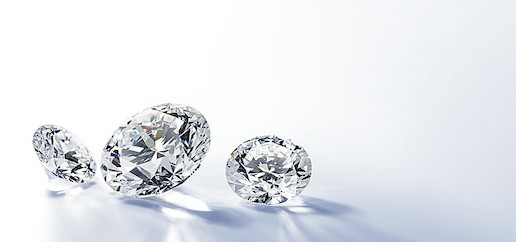
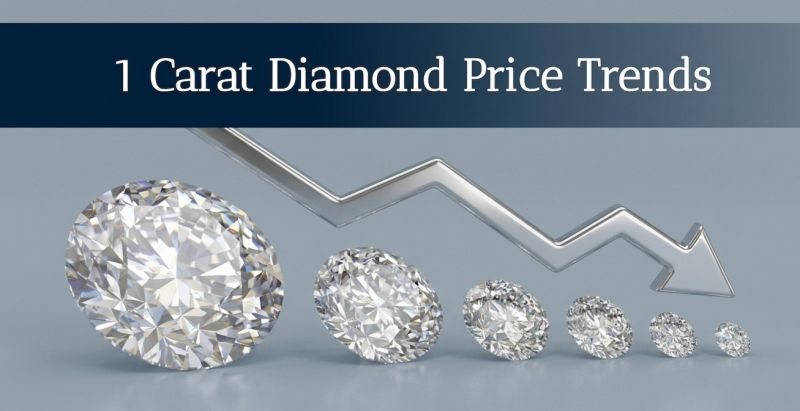
The 1‑carat diamond market faced continued price pressure in March 2026, but the story is not a simple “prices are falling.” The data shows a market that is refining itself buyers are becoming much more selective, and the quality gap is widening rapidly. Top‑tier stones are holding their value, while lower‑quality goods are seeing sharper discounts, slower turnover, and rising inventory levels.

March 2026 Price Movement at a Glance -

Across all categories, 1‑carat diamond prices declined in March 2026. However, the impact was far from equal.

The diamond market showed varied price movements across different quality segments. Top-quality diamonds (D–F, IF–VVS) experienced a modest average price decline of around 1.5%, indicating that premium goods remain relatively stable with consistent demand.

In comparison, mid-quality diamonds (G–J, VS) saw a sharper decline of approximately 2.4%, suggesting that value-conscious buyers are increasingly shifting their preference toward higher-quality stones.

Meanwhile, lower-quality diamonds (K–M, SI) recorded the weakest performance, with price declines ranging from about 2.1% to 4.9%. Within this segment, SI clarity diamonds were the hardest hit, experiencing the steepest drop of nearly 4.9%.

Within the lower‑quality bracket, the data is even more revealing:

IF–VVS (K–M colors) → down 2.1%

VS (K–M colors) → down 3.0%

SI (K–M colors) → down 4.9% (largest decline)

The pattern is unmistakable: price pressure is strongest where clarity and color are weakest. Buyers are avoiding lower‑quality goods unless they are heavily discounted. Demand is not disappearing, it is migrating upward to better‑made stones.

Why Is This Happening? A Market That Is Refining, Not Crashing

The 1‑carat diamond segment is undergoing a “quality rotation.” Several structural forces are driving this shift.

Lab‑Grown Diamonds Have Reshaped the Low‑End Market -

Lab‑grown diamonds now account for a significant share of the market, particularly in the lower‑price tiers. By 2026, a 1‑carat D/VVS2 lab‑grown diamond typically retails for USD 280–320, while a comparable natural stone wholesales around USD 7,050.

At these price levels, many budget‑conscious buyers choose lab‑grown for lower‑quality natural goods, which intensifies price pressure on natural SI and lower‑color stones.

According to industry estimates, lab‑grown diamonds now represent approximately 61% of US engagement‑ring center stones. The rapid adoption of lab‑grown stones has permanently altered demand elasticity for lower‑quality natural diamonds.

Supply Is Tightening – But Only for High‑Quality Goods

Global natural diamond supply is at multi‑decade lows. In 2025, production was estimated at just over 100 million carats the lowest since 1992 and 2026 supply is forecast to rebound only moderately to around 105 million carats. De Beers has cut its 2026 production guidance to 21–26 million carats, down from a previous 26–29 million carats.

However, this supply squeeze is not uniform. High‑quality diamonds (D–F, IF–VVS) remain scarce and in demand. Lower‑quality goods face inventory build‑ups as buyers pass them over.

Buyers Are Better Educated and More Selective -

Modern buyers understand the 4Cs. They know that an “eye‑clean” SI diamond may offer a better value proposition than a flawless stone but they also know that not all SI diamonds are created equal. The result is a barbell effect: demand is concentrating at the top (premium investment‑grade stones) and at the value‑sweet spot (well‑cut VS–SI stones), while the middle‑low segment struggles.

The March 2026 data aligns with broader market indices.

CaratX’s own market data shows a similar trend, with lower‑quality goods (SI, K–M) declining more sharply.

For a more detailed breakdown of February 2026 price movements and inventory trends, read CaratX’s previous analysis that report covers high‑end corrections, mid‑range stability, and the emerging “color gradient” effect in K–M diamonds.

Strategic Implications for Sellers and Buyers -

For Sellers

Lower‑quality inventory (SI, K–M) is becoming illiquid. Expect longer holding periods and deeper discounts unless you adjust pricing aggressively.

Premium goods (D–F, IF–VVS) remain the best hedge. If you have access to high‑quality stones, now is the time to list them on platforms with international reach.

Consider selling internationally. Price pressure varies by region. CaratX connects sellers to buyers in 18+ countries, helping you find the right market for your inventory.

Register as a seller on CaratX to start selling to B2B and B2C buyers worldwide.

For Buyers (Retail & Wholesale)

This is an excellent time to buy high‑quality diamonds at slightly reduced prices. The 1.5% discount on D–F, IF–VVS stones is modest, but it’s a window of opportunity.

Avoid lower‑quality goods unless the discount is significant. SI and K–M stones may see further price erosion.

Shop certified diamonds. Always prioritize GIA or IGI certification to ensure you know exactly what you’re buying.

Shop natural diamonds on CaratX – we offer a curated selection of certified diamonds at competitive prices.

Explore our jewelry collection – from engagement rings to fine jewelry, we have something for every occasion.

Frequently Asked Questions (FAQs)

Q1: Why did 1‑carat diamond prices drop more for lower‑quality stones in March 2026?

A: Lower‑quality stones (SI clarity, K–M color) face the strongest competition from lab‑grown diamonds, which offer similar appearance at a fraction of the cost. Additionally, buyers are increasingly educated about the 4Cs and prefer to pay a premium for better‑made stones rather than accepting lower‑quality goods.

Q2: Is now a good time to buy a 1‑carat diamond?

A: Yes but focus on high‑quality stones (D–F, IF–VVS). These have seen only a ~1.5% price decline and are likely to hold or recover value faster. Lower‑quality stones may continue to slide.

Q3: Should I sell my lower‑quality diamonds now?

A: If you hold SI or K–M diamonds, consider adjusting your pricing aggressively to move inventory, or explore international markets through a platform like CaratX. Holding onto lower‑quality goods may lead to further price erosion.

Q4: How does CaratX help sellers?

A: CaratX is a global B2B and B2C marketplace that connects sellers with buyers in 18+ countries. We offer seller plans, bulk listing tools, and access to a wide network of international buyers. Register here to get started.

Q5: Where can I learn more about diamond grading?

A: The GIA website (gia.edu) offers free educational resources on the 4Cs, diamond formation, and grading standards. CaratX also publishes regular market insights and educational content – follow us for updates.

Start Selling or Shopping on CaratX Today -

Whether you are a seller looking to move inventory or a buyer seeking the best value, CaratX provides a trusted, transparent marketplace for natural diamonds, gemstones, and fine jewelry.

Sellers: Register now to start selling to buyers in 18+ international countries.

Buyers: Shop natural diamonds and jewelry at competitive prices.

Explore gemstones: Shop gemstones at unbeatable prices.

Learn more: Visit our pricing page for details on seller plans and marketplace fees.

Follow CaratX for more insightful and educational content. Stay ahead of the market – sign up for our newsletter today.

0 Comments

Please login to leave a reply.