

💎 De Beers Revises Rough Diamond Index -
Home
News And Media 💎 De Beers Revises Rough Diamond Index - SHOP NOWHome
News And Media 💎 De Beers Revises Rough Diamond Index - SHOP NOWApr, 29, 2026 by Archit Mohanty 0 Comments
In an industry built on prestige, price discipline, and controlled supply, the last 24 months have been nothing short of a correction. For generations, diamond pricing was as much about psychology as it was about carat weight. But in late 2025 and early 2026, two seemingly contradictory headlines emerged:
"Anglo American Revises Rough Diamond Index – Prices Fell 18% in Q1 2025" "De Beers Sales Jump 64% After Rough Diamond Price Cuts"
At first glance, this looks like a paradox: How can sales skyrocket if prices are crashing? However, a deeper analysis of the revised data and market dynamics reveals a strategic sea change. De Beers moved away from rigid official list prices toward a "stock-rebalancing" strategy involving bulk sales to select sightholders, one that ultimately reignited demand.
This guide explores the revised Anglo American data, the fragile two-tier market of 2025–2026, and why pricing discipline is the industry's greatest weapon.
For those looking to capitalize on these shifts, platforms like CaratX are now the essential gateway for B2B and B2C diamond and jewelry sales in 18+ countries.
For further in-depth wholesale inquiries and listings, sellers can register on the CaratX marketplace here to start distributing globally.
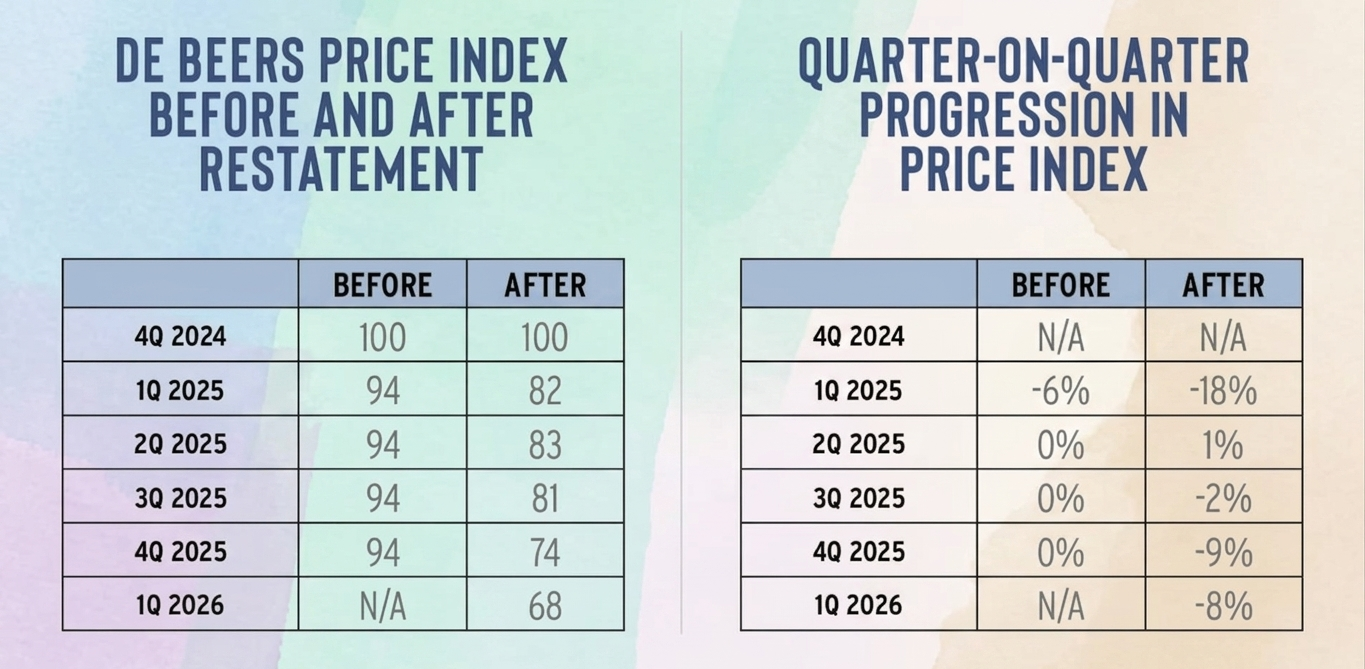
Traditionally, De Beers reported only its official list prices. However, in the first quarter of 2026, parent company Anglo American dropped a bombshell on the market. They restated the historical data to include the impact of "stock-rebalancing actions." This adjustment tells a much harsher story about 2025.
The Old Data (Official List Prices): Rough prices fell only 6% in Q1 2025.
The Updated Data (Including Discounts): Rough prices fell a staggering 18% in Q1 2025.
Subsequent Quarters: Prices stayed mostly stable during Q2 and Q3 of 2025, only to suffer another 9% decline in Q4 2025.
2026: The rough price index dropped another 8% in Q1 2026.
According to the Rapaport report, De Beers executed a strategy to move "slower-moving rough diamonds" through discounted bulk sales to selected sightholders.
Previously, the index excluded this impact. The goal was simple:
Reduce excess inventory quietly to free up cash flow.
Move weaker goods (smaller, lower-quality rough) without wrecking the market perception of high-value stones.
Avoid a psychological meltdown. By keeping official prices artificially higher while offering secret deals, De Beers prevented a wholesale panic across the secondary market.
This revelation confirms that rough demand in 2025 was far weaker than initially believed, and that aggressive inventory management has become the new normal.
The updated data highlights a market that is no longer monolithic. The diamond market of 2026 is deeply divided, a bifurcation that has been tracking closely.
According to the Diamond Index, the demand split is acute:
The Losers (Smaller, Lower-Demand Goods): The index for 0.30-carat diamonds slumped 20.3% in 2025. 0.50-carat goods fared even worse, tumbling 26% .
The Winners (Luxury & Large Carat): The index for 3-carat goods only dipped 0.3% in 2025, remaining almost flat. Stones of 5 carats and larger saw price increases in February 2026 due to tightening supply.
The mid-market is being squeezed by high gold prices and competition from lab-grown diamonds. However, the ultra-wealthy consumer remains resilient, driving demand for rarity and high-carat weight. The middle market and smaller melee diamonds, often used in fashion jewelry, are seeing price erosion.
Entering 2026, De Beers took a scalpel to its pricing strategy. Instead of blanket cuts, they strategically lowered prices on 1 to 2 carat rough diamonds and some 2 to 4 carat goods the exact segments where inventory had been piling up.
The result was immediate and dramatic:
Rough Sales Volume: Rose 64% YoY to 7.7 million carats.
Consolidated Sales: Increased 53% .
Revenue: Jumped 25% to $648 million.
The Trade-off: The Average Selling Price fell 19% to $101 per carat.
This 64% volume surge proves that price elasticity is alive and well in the rough market. When prices align with reality (especially for the pressured 1–2 carat segment), buyers cutters and polishers in India and Belgium return immediately to restock.
While sales are up, De Beers remains cautious. The company increased production by 17% in Q1 2026 (7.1 million carats), driven by the Gahcho Kue mine in Canada and Venetia in South Africa. However, they have slashed the full-year 2026 guidance drastically to between 21 million and 26 million carats (down from a previous 26–29 million).
The diamond market recovery is not smooth sailing. According to the World Diamond Council, the $117 billion U.S. jewelry industry, which supports over 200,000 American jobs, is at risk due to tariff reviews on natural diamonds.
US Tariffs on Indian Goods: India, the world's largest diamond polishing hub, saw export activity slow under the weight of US tariffs. In April 2026, the Middle East war added new pressures, freezing trade in Israel and Dubai amid missile strikes.
In March 2026, the US tariff on diamond exports was set to be eliminated, and a US-India trade agreement is expected to provide 6–7% revenue growth for Indian polishers in FY2027.
Sanctions on Russian diamonds (via Alrosa) continue to reroute global supply chains, though this has also tightened supply for larger, high-quality stones, indirectly supporting the upper end of the market.
The rise of synthetic diamonds remains a disruptive force. However, there is a shift happening: prices for lab-grown diamonds have collapsed (down ~75% since 2020). Some retailers are shifting back to natural diamonds due to changing economics and the desire for lasting value.
The Kimberley Process Certification Scheme (KPCS) remains the gold standard for ethical trade. It is a UN-mandated global initiative that has successfully stemmed the flow of 99.8% of the global production of conflict diamonds (or "blood diamonds") .
Before the KP's implementation, conflict diamonds accounted for an estimated 4–15% of the global market; today, that figure is consistently below 1%.
As the market bifurcates (high-end holds, low-end fights for volume), liquidity becomes king. Whether you are a manufacturer sitting on certified diamonds or a retailer looking for specific shapes, you need a platform that reflects the new "dynamic" pricing reality.
Global Reach: Sell to 18+ international countries.
Flexible Listings: Whether you are offloading specific "melee" parcels at competitive rates (mirroring the De Beers strategy) or listing 5-carat plus collectibles, CaratX's marketplace connects you directly to B2B and B2C buyers.
Jewelry Ready: You can now sell International Jewelry seamlessly through the CaratX seller plan .
Gemstones: Looking to diversify? You can also shop gemstones at unbeatable prices to pair with your diamond inventory.
Shop Natural Diamonds: https://www.caratx.com – Browse our curated inventory.
Seller Registration: Register here to become a vendor.
CaratX Pricing Plans: Check out the details for launching your products.
Discover Gemstones: Shop Gemstones for a competitive market edge.
Q1: Why did De Beers hide the price cuts in the original 2025 data? A: De Beers utilized "stock-rebalancing" discounts for select sightholders rather than slashing official list prices. This was a strategic move to reduce excess inventory of slower-moving goods without damaging overall market sentiment and the perceived value of premium diamonds.
Q2: Are rough diamond prices going to recover in 2026? A: The market remains uncertain. While De Beers saw a 64% volume increase after Q1 cuts, production guidance has been lowered to 21–26 million carats. Geopolitical tensions and US tariff concerns still weigh heavily, though a US-India trade deal could stabilize prices for mid-sized goods.
Q3: What are "sightholders" and why are they important? A: Sightholders are the world's leading diamantaires (cutters/polishers) who buy roughly 90% of De Beers' rough diamonds by value. They receive regular allocations (sights) in exchange for commitments. The recent discounted bulk sales were specifically offered to this elite group to clear inventory.
Q4: Is it safe to buy diamonds online in 2026? A: Yes, provided the marketplace is secure and verifies origins. Platforms like CaratX provide transparent B2B/B2C supply chains backed by modern digital standards. Always look for KPCS certification and return policies.
Q5: How does the Kimberley Process ensure my diamond is conflict-free? A: The Kimberley Process Certification Scheme (KPCS) requires that every shipment of rough diamonds crossing an international border must be in a tamper-resistant container with a government-validated certificate. This tracks the diamond from mine to export, ensuring it has not funded armed conflict. Academics note it has reduced conflict diamonds from over 15% of the market to under 1% today.
Start selling to diamonds in 18+ International countries: www.caratx.com/register
Sellers register on CaratX marketplace here to start selling to B2B and B2C buyers: www.caratx.com/register
You can now sell Jewelry Internationally to buyers through our CaratX seller plan: www.caratx.com/register
Shop gemstones from our CaratX marketplace at unbeatable price: https://caratx.com/search-results/gemstones
Shop natural diamonds from here: https://caratx.com/search-results/Natural
Follow CaratX for more insightful and educational content about navigating the global diamond trade.
Aug, 06, 2022
Aug, 06, 2022


0 Comments
Please login to leave a reply.