
Global Diamond Market Update 2026, Premium Large Diamonds Stay Strong Across Major Trading Centers
Home
News And Media Global Diamond Market Update 2026, Premium Large Diamonds Stay Strong Across Major Trading Centers SHOP NOWHome
News And Media Global Diamond Market Update 2026, Premium Large Diamonds Stay Strong Across Major Trading Centers SHOP NOWMay, 08, 2026 by Archit Mohanty 0 Comments
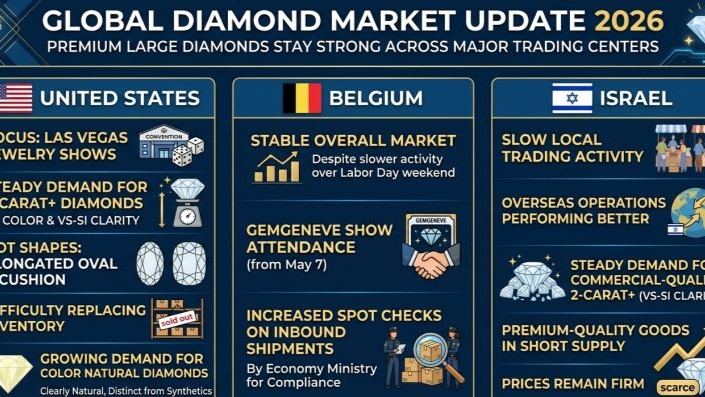
The US market is laser-focused on Las Vegas, wholesalers can't replace 2-carat SI goods fast enough, and China just blew up its diamond tax code. If you're not tracking what's happening in each key market, you're trading blind. This global diamond market breakdown covers five major trading hubs, the natural vs. lab divide, China's VAT shock, and what it all means for your business.
Before diving into key hubs, here is a snapshot summary of current market conditions across major diamond trading centers:
In the United States, the diamond market sentiment remains focused and active, largely driven by momentum from the Las Vegas trade shows. Demand is strongest for 2 carat and larger diamonds in the F–I color and VS–SI clarity ranges, particularly elongated ovals and cushion shapes, along with low-color natural diamonds. However, suppliers continue to face challenges replacing inventory at acceptable price levels, while melee goods remain comparatively slow.
Belgium’s diamond market remains stable, supported by strong attendance and trading activity surrounding the GemGeneve show. Polished diamond trading continues at a steady pace, although the industry is facing operational challenges due to random customs checks on inbound shipments, which are creating logistical uncertainties.
In Israel, the domestic market remains relatively slow, although overseas trading activity continues to support business. Demand is strongest for 2 carat and larger VS–SI commercial goods, while premium merchandise remains in limited supply. The Mother’s Day season delivered only minimal improvement in trading activity, and wartime-related disruptions continue to affect market data and overall business visibility.
India’s diamond market has softened due to the seasonal summer slowdown. Manufacturers and traders are maintaining strict supply discipline and approaching rough diamond purchases cautiously. Buyers remain highly price-sensitive, contributing to slower trading conditions and more conservative purchasing behavior across the market.
Hong Kong continues to experience solid demand, particularly from investment buyers seeking high-value diamonds. The strongest demand is concentrated in 5 to 20 carat diamonds in the D–F color and IF–VVS clarity ranges, especially in round, pear, and oval shapes. However, diamonds below 0.50 carats remain slow-moving, while ongoing China tax reform adjustments continue to create ripple effects across regional trading activity.
Market Focus: The US market is currently pivoting toward the major Las Vegas jewelry shows, a key seasonal driver for wholesalers and retailers. The JCK Las Vegas show (traditionally held in early June) and Couture serve as pivotal platforms where new collections launch and major deals close.
Demand Characteristics: Large wholesalers report steady demand for 2 carat and larger diamonds in the F-I color, VS-SI clarity range. Elongated fancy shapes particularly ovals and cushions remain extremely hot sellers, aligning with broader consumer references tracked by major industry studies.
Low-color goods (I color range) are notably sought-after. Consumer psychology appears to favor lower color grades specifically to provide clear visual evidence of a diamond being natural rather than lab-grown, as lab-grown stones typically achieve higher color grades more affordably.
The melee market (small diamonds under 0.20 carats) remains slow, reflecting a broader softening in smaller-stone demand reported in the April Market Report.
Supply Constraints: Wholesalers are struggling to replace sold inventory at the right price. This "inventory gap" stems from disciplined production cuts by major miners. De Beers' parent Anglo American cut 2026 production guidance to 21–26 million carats, down from the previous 26–29 million carats. Global natural diamond supply in 2025 was the lowest since 1992, just over 100 million carats.
US Market Data: Diamond jewelry revenue grew 2.5% in Q1 2026, but unit volume fell 11%, with growth concentrated in the over-$2,500 high-end tier. Total US jewelry sales are projected to grow 5–6% in 2026. Polished diamond imports are down 86% year-over-year, while rough imports have collapsed 98%.
Explore Natural Diamonds Shop natural diamonds from here - CaratX Marketplace
Market Conditions: The Belgian market remains stable, though trading was subdued during the extended Labor Day long weekend. Belgian industry players showed strong presence at the start of the GemGeneve show on May 7, one of Europe's premier fine jewelry events.
Regulatory Activity: The Belgian Economy Ministry (FPS Economy) is currently carrying out random spot checks on inbound polished shipments. This increased regulatory scrutiny aligns with broader EU efforts to ensure product origin transparency and compliance with trade rules.
Antwerp's Role: Antwerp continues to serve as the diamond industry's primary gateway to Europe. Polished diamond exports fell 17% in Q1 2026, rough exports fell 23%, while rough imports surged 76%.
Local vs. Overseas Activity: Domestic trading remains slow, with minimal improvement during the Mother's Day period. However, companies maintaining overseas operations or affiliates in key markets (US, Hong Kong, India) remain active and are capitalizing on international opportunities.
March 2026 data remains unreleased due to wartime conditions, with analysts expecting a sharp drop in reported figures.
Demand Patterns: Some demand exists for commercial goods (VS-SI clarity) in 2 carat and larger sizes. Premium-quality merchandise remains in short supply with firm prices, reflecting broader industry trends where higher-quality goods maintain value even amid market softness.
Market Outlook: The Indian diamond industry is entering its traditional summer slowdown. Sentiment and trading activity have decreased, with few signs of extra purchasing ahead of the Las Vegas shows. Buyers are cautious and highly price-sensitive.
ICRA's Outlook: India's cut and polished diamond exports are projected to shrink further by 7-10% in FY2026 to around $12 billion, after hitting a 20-year low in FY2025. ICRA maintains a "Negative" outlook for the sector, citing demand pressures in the US and China combined with uncertainty over potential US tariff impositions.
Supply Discipline: Despite the slowdown, the market is heavily dependent on disciplined supply to maintain recovery. Manufacturers are buying rough carefully, and miners (particularly De Beers and ALROSA) are producing significantly under capacity to manage prices and prevent oversupply.
Lab-Grown Impact: Lab-grown diamonds have captured 8% of India's polished diamond exports in FY2025, up from just 1% in FY2019, driven by lower costs and increasing consumer preference for ethically sourced products.
Investment Demand: Hong Kong shows solid investment demand for 5 to 20 carat, D-F color, IF-VVS clarity diamonds in round, pear, and oval shapes. These ultra-high-quality stones serve as portable stores of value for high-net-worth individuals and institutional investors.
Split Consumer Preferences: Under-0.50 carat diamonds are slow, reflecting a bifurcated market. Younger consumers are leaning toward lab-grown diamonds, while older consumers prefer natural diamonds due to their cultural significance, perceived rarity, and higher emotional and resale value.
Catalyze Your Sales: Start selling to diamonds in 18+ International countries - CaratX Sellers register on CaratX marketplace here - CaratX Registration
One of the most significant developments affecting the global diamond market is China's VAT reform, effective November 1, 2025.
The Chinese government abolished both the VAT exemption for rough diamonds and the "levy-and-immediate-rebate" mechanism for polished diamonds traded through the Shanghai Diamond Exchange (SDE). Importers must now pay the full 13% VAT at the point of import, replacing the earlier arrangement where they paid 13% but immediately received a 9% refund (effective 4% burden).
For two decades, China's diamond industry benefited from this unusual fiscal structure. The removal of the VAT benefit immediately reshapes the economics of doing business. For the natural diamond midstream, this means:
Higher upfront cash requirements — VAT now payable in full upon import
Extended cash conversion cycle — VAT recoverable only after goods are sold
Margin compression — Midstream margins will likely shrink
Retail price adjustments — Higher landed costs meeting stable or soft demand
More details about our Pricing - CaratX Pricing Page
Although the policy is neutral in wording, its consequences extend to lab-grown diamonds. Previously, polished LGDs processed overseas and imported via the SDE could enjoy the same VAT concessions. Now, with natural diamond costs rising due to full VAT application, lab-grown diamonds' price advantage may be further amplified.
In the broader Chinese jewelry market, 2025 diamond market size grew 11.6% to 48 billion yuan, with general-trade natural diamond imports rising 65%. However, profit margins remain under pressure. A-listed jewelry companies saw net profits drop 34.69% year-over-year in 2025 compared to 2024.
In 2025, lab-grown diamonds accounted for approximately 61% of the US engagement ring market, while natural diamonds represented about 39% of total market share. This reflects the continued rise in consumer acceptance of lab-grown diamonds, particularly among younger buyers seeking larger stones at lower price points.
The average retail price of a 1-carat natural diamond in 2025–2026 remained around $4,200, whereas a comparable lab-grown diamond sold for approximately $750 to $1,000. Over the period from 2020 to 2025, natural diamond prices declined by roughly 30% for 1-carat stones, while lab-grown diamond prices experienced a much sharper decline of approximately 74% due to increasing production efficiency and oversupply.
Despite the price differences, the average engagement ring spending in 2025 remained relatively strong across both categories. Consumers purchasing natural diamond engagement rings spent an average of over $5,000, while buyers of lab-grown diamond rings spent approximately $4,600 on average.
Lab-grown diamonds also continued to drive demand for larger center stones. In 2025, the average size of a natural diamond engagement ring in the US was approximately 1.13 carats, while the average lab-grown diamond engagement ring reached around 1.70 carats, highlighting consumers’ preference for maximizing size and visual appearance at a lower overall cost.
The Knot's 2026 Real Weddings Study of over 10,000 US couples found that 61% of engagement ring purchases in 2025 featured lab-grown diamonds, a 239% increase since 2020. Notably, 40% of couples said it was important that their stone be lab-grown, driven by economic pragmatism and evolving values.
For natural diamonds: 1.70 carat lab-grown diamond engagement rings now retail for what 1.00–1.25 carat natural diamonds cost just three years ago. Natural diamonds maintain value through controlled extraction volumes and enhanced certification systems, while lab-grown diamonds improve competitiveness via technological innovation and cost optimization.
In 2025, global natural diamond supply declined to approximately 100 million carats, marking the lowest production level since 1992, according to industry analyst Paul Zimnisky. Supply is projected to recover slightly in 2026, with forecasts estimating global production at around 105 million carats.
De Beers, through guidance issued by Anglo American, projected its 2026 production to range between 21 million and 26 million carats, reflecting continued efforts to balance supply with market demand and pricing stability.
China’s natural diamond imports increased significantly in 2025, rising approximately 65% year-over-year, according to the Gems & Jewelry Trade Association of China. At the same time, China continued to dominate the lab-grown diamond sector, producing an estimated 45 to 50 million carats in 2025, representing roughly 63% of total global lab-grown diamond production.
The lab-grown diamond market continued to experience pricing pressure in early 2026. Wholesale prices for lab-grown diamonds declined by approximately 14% year-over-year during the first quarter of 2026, according to industry reports.
Meanwhile, US polished diamond imports recorded a dramatic decline of approximately 86% year-over-year in 2026 year-to-date figures, based on US government trade data, highlighting ongoing shifts in inventory management, demand patterns, and global supply chain adjustments.
India’s cut and polished diamond (CPD) export sector is also expected to remain under pressure. According to projections by ICRA, Indian CPD exports for FY2026 are forecast to reach approximately $12 billion, representing a decline of around 7% to 10% compared to previous periods.
Natural diamonds are at a crossroads. Long-term demand remains intact, particularly at higher price points, but survival depends on sharper differentiation, renewed marketing focus, and conscious effort to protect the luxury perception that has underpinned the category for decades.
The supply control strategy remains the primary mechanism supporting natural diamond prices. De Beers is currently producing at as much as 35% under capacity, with ALROSA estimated at ~15% under capacity. This means over 10 million carats of additional production could theoretically be turned back on relatively quickly if demand returns.
Lab-grown diamonds now account for 61% of US engagement ring sales in 2025, up from 25% in 2020. Global wholesale prices continued to slide in Q1 2026 with no clear bottom yet in sight, though the rate of decline has eased compared to 2025.
Producers are migrating toward uniformly higher-grade output, with SI-clarity quotes being dropped entirely from some wholesale lists. Retail demand remains strong with double-digit unit-volume growth, but average ticket size remains flat as consumers trade up within stable budgets.
Star Seller Advantage: Start selling to diamonds in 18+ International countries - CaratX
Sellers register on CaratX marketplace here - CaratX Registration
Sellers register to start selling to 18+ buyers now - CaratX Registration
Buyer Opportunities:
Shop gemstones from our CaratX marketplace at unbeatable price - CaratX Marketplace Shop natural diamonds from here - CaratX Marketplace
Pricing and Policy: More details about our Pricing - CaratX Product Launch Page
Yes. Lab-grown diamonds have the same physical, chemical, and optical properties as natural diamonds. However, under FTC guidelines, the word "diamond" alone refers only to natural diamonds, and lab-grown stones must be clearly labeled as "laboratory-grown" or "laboratory-created".
Natural diamond prices have declined significantly since 2021, with 1-carat stones falling from ~6,000to 6,000to 4,200. However, producers are deliberately restricting supply (De Beers is producing 35% under capacity) to support prices, and premium-quality stones (5-20 ct, D-F, IF-VVS) remain in strong investment demand.
The reform raised natural diamond import costs from effectively 4% to full 13% VAT, leading to higher landed costs. This makes natural diamonds relatively more expensive compared to lab-grown stones, potentially accelerating market share shifts.
Elongated ovals and cushions are extremely hot in the US market. Round brilliants continue to dominate ~62% of global unit sales, but fancy shapes like emerald, marquise, and pear cuts show steady growth.
Modern natural diamonds are largely ethical by design thanks to the Kimberley Process Certification, which guarantees conflict-free sourcing. The natural diamond industry directly supports 10 million people worldwide, with 80% of generated value remaining in local communities.
Yes. CaratX enables sellers to reach buyers in 18+ international countries. Register at caratx.com/register to start selling diamonds and jewelry globally.
Follow CaratX for more insightful and educational content on the global diamond trade. Join the CaratX marketplace today to start selling to 18+ international countries.
Jun, 18, 2026
Aug, 06, 2022
Aug, 06, 2022
0 Comments
Please login to leave a reply.