
The global diamond industry is undergoing a seismic shift. For decades, the Round Brilliant Cut has been the undisputed king of the market, hailed for its unrivaled fire and brilliance. However, current fancy shape diamond trends indicate a decisive pivot toward individuality, elongation, and mathematical proportions.
At CaratX, we are witnessing this evolution in real-time on our B2B and B2C marketplace. Data suggests that while round diamonds remain a staple, fancy shapes particularly elongated silhouettes are outperforming the market in both price resilience and demand, especially in the +2 carat segment.
Here is your definitive guide to the 2026 fancy shape diamond market, why liquidity is tied to proportions, and how to navigate this new landscape.
The Macro Shift: Why Fancy Shapes Are Winning
The desire for uniqueness is the primary driver of the fancy shape boom. Unlike rounds, which are valued for strict symmetry, fancy shapes offer a balance of personality and optical illusion. Modern buyers are prioritizing finger coverage and esthetics over traditional brilliance metrics.
According to a study on consumer behavior by the Gemological Institute of America (GIA), there is a growing appreciation for the individuality of fancy shapes, as they allow consumers to express personal style beyond the classic round brilliant.
Furthermore, the "Value Index" is changing. A well-cut 2-carat Oval Cut Diamond often has the spread (face-up size) of a 2.3-carat round. This "look for less" mentality is driving budget-savvy millennials and Gen Z buyers toward elongated shapes.
Trending Shapes in Detail: The Winners of 2026
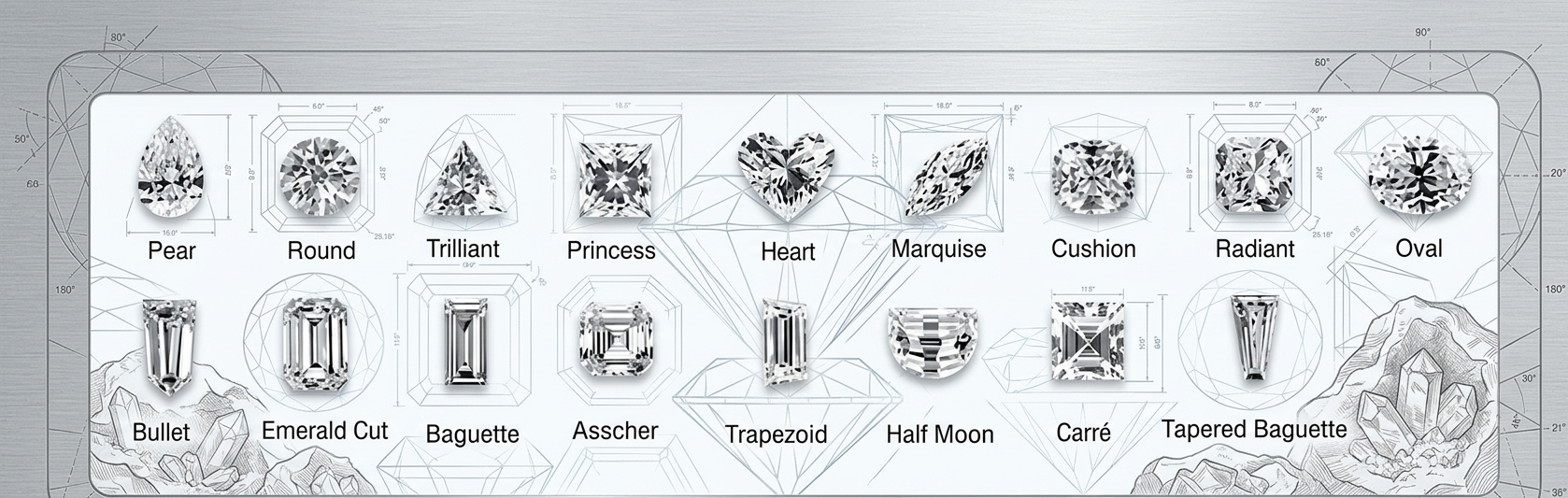
1. The Reign of Elongation: Ovals, Marquise, and Emerald Cuts
Elongated shapes are currently the stars of the show. In the +2 carat range, these shapes are trading at significant premiums compared to their standard counterparts.
Oval Cut Diamond: The Oval remains the top-selling fancy shape in the United States. Demand is highest for stones with a length-to-width ratio between 1.45 and 1.50. This ratio provides the perfect balance of elongation (making fingers look slimmer) without the "bow-tie" effect that plagues poorly cut stones.
On CaratX, we see robust liquidity for Ovals in the D–I color range and VS–SI clarity.
Marquise Cut Diamond: Currently the most expensive fancy shape per carat. The Marquise offers the largest face-up spread of any shape. If you are looking for a stone that looks significantly larger than its carat weight, the Marquise Cut Diamond is the optimal choice. However, due to its pointy ends, it requires precise faceting to prevent chipping and maximize brilliance.
Emerald Cut Diamond: The "Hall of Mirrors" effect is driving demand for the Emerald cut. Buyers are shifting away from high-octane sparkle toward the sophisticated, understated elegance of step cuts.
Clarity is paramount here; because the pavilion is open, inclusions are more visible. CaratX recommends Eye-Clean VS2 or higher for Emerald cuts.
2. The Supply Crunch: Radiants & Cushions
The market is currently experiencing a shortage of specific cuts:
Long Radiant Cut Diamond: The hybrid nature of the Radiant (combining the trim cut of an emerald with the brilliance of a round) makes it highly sought after. Elongated Radiants are scarce in the market because cutters often lose more rough weight to produce them.
This scarcity is pushing prices upward on the CaratX marketplace.
Elongated Cushion Cut Diamond: There is a distinct price bifurcation in the cushion category.
3. The Underperformers: Princess Cuts
While still a classic shape, the Princess Cut is currently the weakest performer among major fancy shapes. Market data suggests a decline in preference for the sharp, square silhouette, with buyers opting for the softer edges of a Cushion or the brilliance of a Radiant instead.
Regional Market Deep Dive
The United States Market: The Look of Size
The US consumer is currently obsessed with visual mass. The trend is simple: "I want it to look as big as possible." This has led to massive demand for elongated Ovals and Pears.
Color/Clarity Preferences: D–I color and VS–SI clarity are the sweet spots.
Liquidity Alert: While Ovals are hot, poorly shaped or "chunky" Ovals (with a low length-to-width ratio) are stagnating in inventory.
Sellers on CaratX must ensure their Ovals have proper proportions to move quickly.
The India Market: The Small Size Softening
The Indian market, a hub for diamond cutting and domestic consumption of smaller sizes, is showing a different trend.
The 0.30 to 0.79 Carat Segment: Prices for Ovals and Pears in this weight range are softening. There is an oversupply of mass-produced smaller fancy shapes.
The Exception: Even in India, well-proportioned long shapes with excellent polish and symmetry are commanding premium prices and moving fast to international buyers via platforms like CaratX .
Price & Liquidity: The Science of Proportions
In the current market, "Shape + Proportion = Value" is not just a slogan; it is the pricing algorithm.
Why Proportions Dictate Price -
The anatomy of a fancy shape diamond is complex. Unlike rounds, which have a universal cut grade, fancy shapes are graded on Polish and Symmetry only not on "Cut." This places the burden of beauty on the manufacturer's skill.
The "Bow-Tie" Effect: In Ovals and Pear shapes, a dark bow-tie across the center can slash the value by 20-30%.
The "Smiling" Effect: In Emerald cuts, a wavy table reflection (smiling) reduces desirability.
The "Spread" vs. "Weight" Trap: A poorly proportioned diamond might retain carat weight but look smaller than a well-cut stone of lower weight.
Current Price Benchmarks -
Based on trading data available through resources like the International Gem Society (IGS) and live transactions on CaratX :
Excellent Cut Fancy Shapes: These are classified as "Hard to Find." Because cutters maximize profit by preserving weight (even if it ruins proportions), truly excellent cuts are rare. They sell at a 15-25% premium.
Poorly Cut Fancy Shapes: These suffer from low liquidity. They are "stuck" inventory. Sellers must discount them heavily to move them, especially in a market where buyers are educated about proportions.
The CaratX Advantage: Navigating the Market
Whether you are a seller looking to liquidate inventory at fair prices or a buyer searching for that perfectly proportioned gem, CaratX provides the infrastructure.
For Sellers: If you have a stock of well-proportioned Long Radiant Cut Diamonds or Emerald Cut Diamonds, now is the time to list.
The demand for these specific cuts outstrips supply. Register on the CaratX B2B platform to access over 18+ international countries.
For Buyers: Looking for a specific length-to-width ratio? Use the advanced filters on CaratX to sort through thousands of natural diamonds and find the stone that meets your exact specifications.
For Jewelry Businesses: You can now sell finished jewelry featuring these trending shapes to a global audience through our integrated seller plan.
The Future: What’s Next for Fancy Shapes?
As we move through 2024 and into 2025, the trend toward personalization will only intensify. We anticipate a rise in demand for Step Cut Pears (a hybrid of Emerald and Pear) and Hexagonal cuts.
Furthermore, the role of AI and Light Performance analysis is growing. Institutions like the American Gem Society (AGS) have long pioneered light performance metrics. We expect these metrics to become standardized for fancy shapes soon, further solidifying the "Proportion = Value" equation.
FAQs: Fancy Shape Diamonds
Q1: Why are elongated fancy shapes more expensive than rounds in some cases? While many rounds are cheaper due to market saturation, high-end elongated fancy shapes (2ct+ Marquise or Emerald) can be more expensive because they require higher rough diamond rough yield loss to achieve the correct proportions. You are paying for the skill of the cutter and the rarity of the shape.
Q2: What is the best length-to-width ratio for an Oval diamond? For a modern look, a ratio of 1.45 to 1.50 is ideal. For a more extreme, elongated look, you can go up to 1.60. However, anything over 1.70 can start to look too narrow or "stringy."
Q3: Are Princess cuts a good investment right now? Based on current CaratX market data and industry reports, Princess cuts are facing softer demand compared to Ovals, Radiants, and Cushions. If you are buying for resale value, other fancy shapes currently offer better liquidity.
Q4: How do I sell my fancy shape diamond quickly? First, ensure it is graded by a reputable lab (like GIA). Second, price it according to its proportions, not just its carat weight. Finally, list it on a global platform like CaratX to access the widest possible pool of vetted buyers.
Sources & Citations
To ensure the accuracy and authority of this report, the following sources were referenced:
Gemological Institute of America (GIA). (2023). Fancy Shape Diamonds: Cutting, Symmetry, and Proportions. Retrieved from GIA.edu
International Gem Society (IGS). (2024). Diamond Price Guides & Market Analysis. Retrieved from Gemsociety.org
Ready to buy or sell in the evolving diamond market?
Don't let poorly proportioned stones sit in your inventory, and don't overpay for mediocre cuts.
Shop Natural Diamonds on CaratX to find perfectly proportioned fancy shapes.
Register as a Seller on CaratX to export your diamonds to 18+ countries today.
Explore our Pricing Plans to take your jewelry business global.
Follow CaratX for more insightful and educational content.